

2 March 2026
Today is the start of Reading Week, and also, Smashword’s annual “Read an ebook week”; all our ebooks are half-price this week!
(7 July 2014) Now that we have finished with the installment version of the first book in The Redemption series, I’ve gone back through my notes searching for other information that might be interesting to our readers. With six books of this series now available in ebook form, there is much in the background of this series now available for examination, giving readers deeper insight into the process of creation, of how the story evolved into its final form. Today, we will examine the names of the three keys, Karble’s sword, Shigmar’s staff, and Melbarth’s rod.
In the fall of 2007, flowing out of work on ‘ancient,’ the original language of this created world, I began to create the character set for this language, explained in a blogpost back in 2012 (12 November 2025 blogpost). I transcribed some of the important things from ancient–like Shigmar’s prophecy, the inscription on the entrance to his tomb (see Book 2), and the seklesi motto. Partially, I wanted to see what they would look like, and how hard it would be to write using the characters I had devised. Also, I had related, in Book 1, the inscription on Karble’s sword, along with Thal’s interpretation of the words. On the back of the sheet with the prophecy transcribed, I did the key names, along with the seklesi motto:
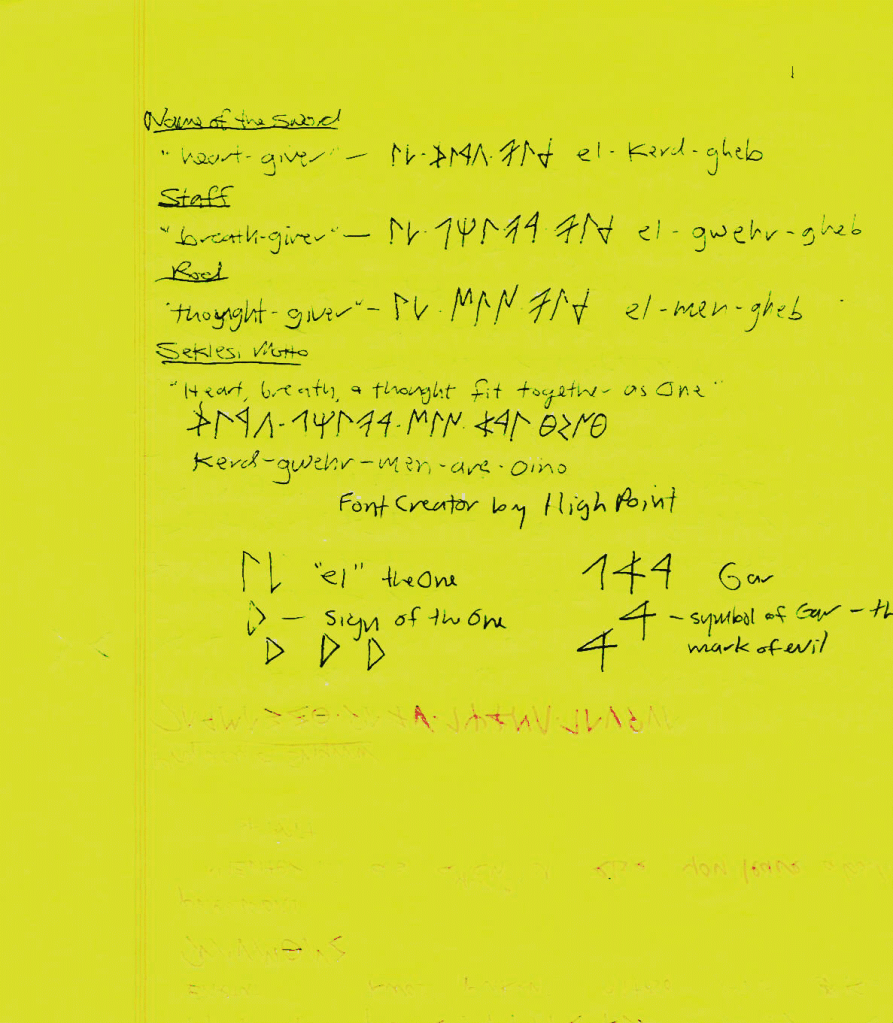
At this point, ancient was only a collection of names–I had yet to decide what the endings of the words would be–so the names of the keys are incomplete: “el-kerd-gheb” still called ‘heart-giver’; “el-gwehr-gheb” or ‘breath-giver’; and “el-men-gheb” or ‘thought-giver’. The same is true of the seklesi motto: none of the endings. More interesting is that below this we see how I created the symbols for both the One and Gar, the one (no pun intended) without the later gender marker, the ‘i’, so I created the sign based only on the letters for ‘e’ and ‘l’, adding the letter for ‘i’ would have complicated the sign, looking as it does like a lightning bolt. (However, I could argue that the three parts of the letter ‘i’ in ancient are present in the three lines in this symbol!) The sign created also became the symbol for elemental light.
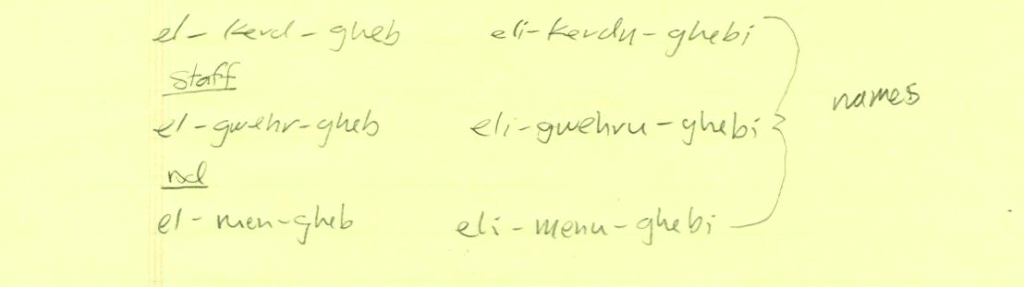
For ‘Gar’, I transcribed the letters as spelled in English, and combined the three of them into a single signal, and it is easy to see how well these three symbols merged! Come back Wednesday for another interesting tidbit from my files! Below, see the final evolution of the names of the keys.
 Clyde B. Northrup
Leave a comment